
If you’ve ever stared at a rational function and wondered why the graph seems to follow a diagonal line off into infinity, you’re already thinking about slant asymptotes. Knowing how to find slant asymptotes is one of those skills that feels tricky at first but clicks beautifully once you understand the logic behind it. In this guide, we’ll walk through everything — from what slant asymptotes actually are to step-by-step methods, real examples, and the mistakes most students make.
Last updated: June 9, 2026
What Is a Slant Asymptote?
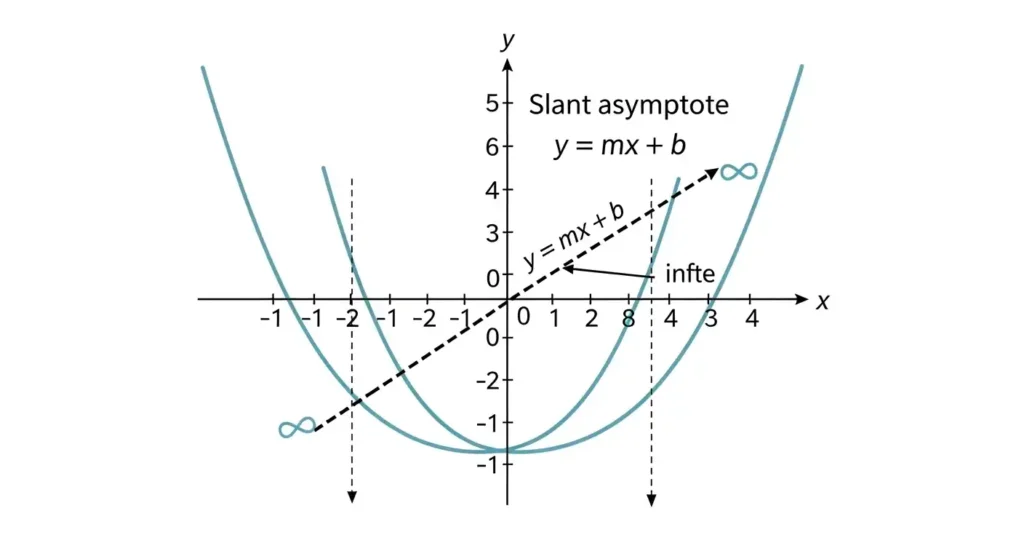
A slant asymptote (also called an oblique asymptote) is a diagonal line that a graph approaches but never quite touches as x moves toward positive or negative infinity. Unlike horizontal asymptotes, which run flat, slant asymptotes have a slope — they’re written in the form y = mx + b.
You’ll find slant asymptotes in rational functions — fractions where both the numerator and denominator are polynomials. The key condition? The degree of the numerator must be exactly one more than the degree of the denominator.
For example:
- f(x) = (x² + 3x + 1) / (x + 2) → has a slant asymptote
- f(x) = (x³ + 1) / (x² – 4) → has a slant asymptote
- f(x) = (x + 5) / (x² + 1) → doesn’t (numerator degree is lower)
How to Find Slant Asymptotes Step by Step
Finding a slant asymptote always comes down to one core technique: polynomial long division. Some textbooks also mention synthetic division or limits, but long division is the most reliable and universally applicable method.
Here’s the process broken down:
How to Unrepost on Instagram: A Simple Guide
Step 1: Check the Degrees
Before anything else, confirm that the numerator’s degree is exactly one greater than the denominator’s degree. If it’s two or more degrees higher, you’re dealing with a curved asymptote, not a slant one. If the degrees are equal or the denominator is higher, you have a horizontal asymptote instead.
Step 2: Perform Polynomial Long Division
Divide the numerator by the denominator just like you would with regular long division. You’re looking for the quotient — the remainder gets left behind.
Find the slant asymptote of f(x) = (x² + 5x + 6) / (x + 1)
Divide x² + 5x + 6 by x + 1:
- x² ÷ x = x → multiply: x(x + 1) = x² + x → subtract: (5x – x) = 4x + 6
- 4x ÷ x = 4 → multiply: 4(x + 1) = 4x + 4 → subtract: 6 – 4 = 2
Quotient: x + 4, Remainder: 2
So the slant asymptote is y = x + 4. The remainder (2) disappears as x → ∞, so you simply drop it.
Step 3: Write the Equation of the Asymptote
Take just the quotient from your division (ignore the remainder entirely) and write it as y = quotient. That’s your slant asymptote.
Using Limits to Verify Slant Asymptotes
Long division gives you the equation directly, but limits can help you verify the result. The formal definition says that y = mx + b is a slant asymptote if:
lim (x→∞) [f(x) − (mx + b)] = 0
In plain language: as x grows huge, the difference between the function and the line shrinks to zero. You don’t need to use limits every time, but understanding this definition helps when you want to confirm your answer is correct.
Practical Examples to Build Your Skills
Example 1 — Basic Rational Function
f(x) = (2x² + 3x − 5) / (x − 1)
Divide 2x² + 3x − 5 by x − 1:
- 2x² ÷ x = 2x → 2x(x − 1) = 2x² − 2x → subtract: 5x − 5
- 5x ÷ x = 5 → 5(x − 1) = 5x − 5 → subtract: 0
Quotient: 2x + 5, Remainder: 0
Slant asymptote: y = 2x + 5
Example 2 — With a Non-Zero Remainder
f(x) = (x² + 2x + 7) / (x − 3)
Divide:
- x² ÷ x = x → x(x − 3) = x² − 3x → subtract: 5x + 7
- 5x ÷ x = 5 → 5(x − 3) = 5x − 15 → subtract: 22
Quotient: x + 5, Remainder: 22
Slant asymptote: y = x + 5 (the remainder 22 is dropped)
Pros and Cons of Using Polynomial Long Division
Pros:
- Works for every rational function where a slant asymptote exists
- Gives you the exact equation in one calculation
- Reinforces your overall algebra skills
- Easy to check your work by multiplying back
Cons:
- Can feel tedious with higher-degree polynomials
- Easy to make arithmetic errors if you rush
- Requires a solid understanding of polynomial division basics
- Doesn’t directly help when the function isn’t a rational expression
Common Mistakes to Avoid
Even students who understand the concept slip up on the execution. Here are the most frequent errors:
- Forgetting to check the degrees first. Jumping straight into division without verifying the degree difference wastes time and leads to wrong conclusions.
- Keeping the remainder. The remainder is not part of the slant asymptote equation. Always drop it.
- Confusing slant and horizontal asymptotes. If the degrees of numerator and denominator are equal, you have a horizontal asymptote — not a slant one.
- Sign errors during subtraction. Long division involves repeated subtraction. A single sign flip early on throws off the entire quotient.
- Thinking the graph can never cross a slant asymptote. Unlike vertical asymptotes, graphs CAN cross slant asymptotes at certain points. The asymptote only describes behavior at infinity.
Best Practices for Mastering Slant Asymptotes
Follow these habits and slant asymptotes will stop feeling intimidating:
- Always start by comparing degrees. Make it a reflex before you do any division.
- Write out every step of long division. Don’t try to do it mentally, especially when coefficients get large.
- Sketch the asymptote on your graph. Drawing y = mx + b as a dashed line before plotting the full curve helps you visualize the end behavior immediately.
- Practice with varied examples. Use functions where the remainder is zero, then practice ones where it isn’t — both are common on exams.
- Double-check using a graphing tool. After finding your asymptote algebraically, confirm it visually. Seeing the curve hug the line is great reinforcement.
- Understand the “why.” Remember that the remainder term, something like 22/(x−3), shrinks toward zero as x grows large. That’s the entire reason you drop it.
Conclusion
Slant asymptotes might seem like a small detail in the bigger picture of calculus and precalculus, but they tell you something genuinely useful about how a function behaves at extreme values. Once you’ve checked the degree condition and walked through polynomial long division a few times, the process becomes surprisingly routine.
The key takeaways: check your degrees first, divide carefully, drop the remainder, and write your asymptote as y = mx + b. Avoid rushing, double-check your signs, and never confuse slant asymptotes with horizontal ones.
With a little practice, finding slant asymptotes becomes one of the more satisfying algebra skills in your toolkit — clear, logical, and completely learnable.
Frequently Asked Questions
1. What is a slant asymptote in simple terms?
A slant asymptote is a diagonal line that a graph gets closer and closer to as x approaches positive or negative infinity. It has both a slope and a y-intercept, written as y = mx + b.
2. How do you know when a slant asymptote exists?
A slant asymptote exists when the degree of the numerator is exactly one more than the degree of the denominator in a rational function.
3. Can a function have both a horizontal and a slant asymptote?
No. A rational function can have one or the other, but not both. If degrees are equal, you get a horizontal asymptote. If the numerator is one degree higher, you get a slant asymptote.
4. Is synthetic division useful for finding slant asymptotes?
Yes, but only when the denominator is a linear expression like (x − c). For more complex denominators, polynomial long division is the safer choice.
5. Can a graph cross its slant asymptote? Y
es — unlike vertical asymptotes, a graph can cross its slant asymptote at finite x-values. The asymptote only describes the graph’s behavior as x approaches infinity.
Source: edX
Related Articles
- Mylawyer360: Your Ultimate Guide to Simplified Legal Solutions
- Area Code Manassas VA: Everything You Need to Know
- Discover Faibloh: The Ultimate Guide to Its Benefits and Uses
Editorial Note: This article was researched and written by the Floral Loft SAC editorial team. We fact-check our content and update it regularly. For questions or corrections, contact us. For readers asking “How to find slant asymptotes”, the answer comes down to the specific factors covered above.