What Are Hyperbolic Shapes and Why Should You Care?
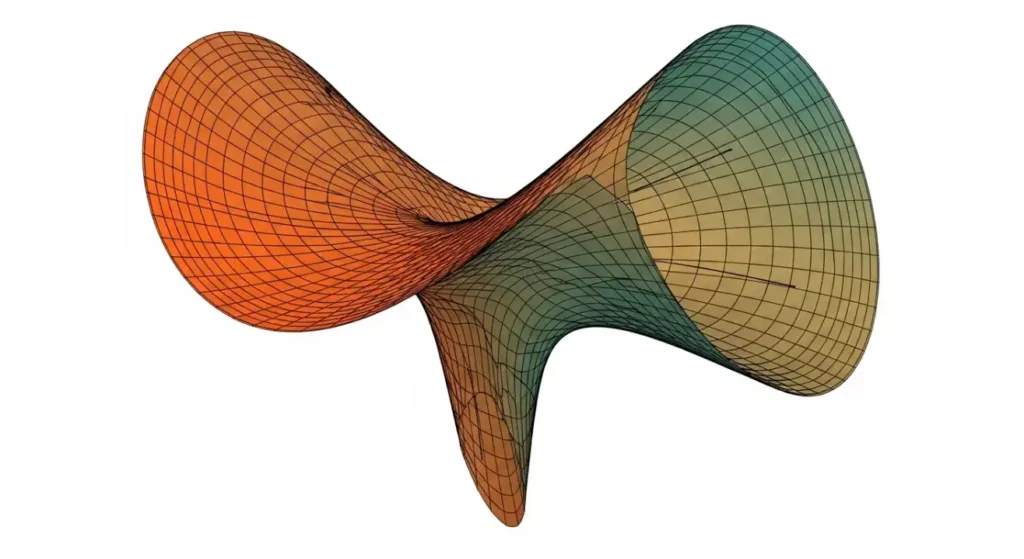
If you’ve ever stared at a Pringle chip and thought “this feels mathematical,” you’re actually onto something. Hyperbolic shapes are geometric forms that curve outward in two directions at once — like a saddle or the flare of a trumpet. They show up more often in real life than most people realize, and understanding them opens a surprisingly fascinating window into how space, nature, and architecture actually work.
Last updated: June 9, 2026
These shapes belong to a branch of mathematics called hyperbolic geometry, and they challenge the way most of us were taught to think about space in school.
What Makes Hyperbolic Shapes Different from Regular Geometry
In the geometry most of us learned in school — flat, Euclidean geometry — parallel lines stay parallel forever, and the angles of a triangle always add up to 180 degrees. Hyperbolic geometry throws both of those rules out the window.
In hyperbolic space, the surface curves away from itself constantly. Imagine a flat sheet of paper. Now imagine stretching every part of it outward until it forms deep, ruffled folds like a lettuce leaf. That’s hyperbolic geometry in action.
The key distinction comes down to curvature:
- Flat surfaces have zero curvature (think a table)
- Spherical surfaces curve inward (like a ball)
- Hyperbolic surfaces curve outward — they have negative curvature
That negative curvature is what gives hyperbolic shapes their unmistakable flared, saddle-like appearance.
Common Examples of Hyperbolic Shapes in Real Life
You don’t have to visit a math department to find hyperbolic shapes. They’re hiding in plain sight all around you.
Natural Examples
Nature loves hyperbolic geometry. Some of the clearest examples include:
- Kale and lettuce leaves — those ruffled, wavy edges are a perfect expression of hyperbolic curvature
- Coral reefs — many coral species grow in hyperbolic patterns, which maximizes surface area for feeding
- Sea slugs — the frilly edges of nudibranch sea slugs follow hyperbolic curves naturally
- Saddle-shaped mountain passes — where terrain dips in one direction and rises in another
Man-Made Examples
Engineers and architects use hyperbolic shapes for practical reasons — they’re incredibly strong and efficient.
- Cooling towers at nuclear and thermal power plants use a shape called a hyperboloid, which provides structural strength with minimal material
- Pringle chips — the saddle shape isn’t just fun to look at; it allows chips to stack without breaking
- Guitar bodies and violin backs often incorporate gentle hyperbolic curves for resonance
- Architectural canopies and roofs — Antoni Gaudí and other architects have used hyperbolic paraboloids for roofing
How to Solve for Slant Asymptote Step by Step
The Mathematics Behind Hyperbolic Shapes
Hyperbolic Paraboloids
The most commonly referenced hyperbolic shape in architecture and engineering is the hyperbolic paraboloid — often called a “hypar.” It’s a doubly ruled surface, which means you can build it entirely out of straight lines even though it looks curved.
This makes it a favorite in architecture. When you see those dramatic sweeping roofs that seem to twist and curl, there’s a good chance you’re looking at a hyperbolic paraboloid.
The mathematical equation for a hyperbolic paraboloid looks like this:
z = x²/a² − y²/b²
In simple terms, the surface goes up in one direction and down in another — that classic saddle shape.
Hyperboloids of One and Two Sheets
Another important family of hyperbolic shapes includes:
- Hyperboloid of one sheet — looks like an hourglass or a cooling tower, pinched in the middle but flaring outward at top and bottom
- Hyperboloid of two sheets — two separate bowl-shaped pieces opening away from each other
Both forms appear in physics, engineering, and computer graphics modeling.
Pros and Cons of Hyperbolic Shapes
Like anything in design and mathematics, hyperbolic shapes come with real advantages — and some genuine challenges.
Pros
- Structural efficiency — hyperbolic surfaces distribute stress very evenly, making them strong without being heavy
- Maximum surface area — the expanded, ruffled geometry packs a huge amount of surface into a small footprint, which is why nature uses it so often
- Aesthetic appeal — the flowing, dynamic curves make hyperbolic shapes popular in modern architecture and product design
- Versatility — they work in contexts ranging from civil engineering to fashion design to abstract sculpture
- Mathematical richness — they’re connected to deep ideas in physics, including the geometry of space-time in Einstein’s theory of general relativity
Cons
- Complexity in construction — while the shapes are efficient, building them precisely requires careful engineering and skilled craftwork
- Hard to visualize mentally — most people find hyperbolic geometry counterintuitive, which makes it harder to teach and communicate
- Software limitations — modeling hyperbolic surfaces accurately requires specialized 3D software
- Cost — the precision required often makes hyperbolic architectural features more expensive to build than conventional alternatives
Common Mistakes People Make When Learning About Hyperbolic Shapes
Even students and professionals trip up on a few recurring misconceptions. Here are the ones worth watching out for.
Confusing hyperbolic with parabolic. A parabola curves in one direction. A hyperbolic paraboloid curves in two opposite directions simultaneously. They sound similar, but they behave very differently.
Assuming curved always means strong. While hyperbolic forms are generally strong, the structural advantages only hold when the shape is correct. An imprecise hyperbolic curve can actually be weaker than a flat surface.
Thinking hyperbolic geometry is purely theoretical. Many people encounter this topic in a math class and assume it’s abstract. In reality, GPS systems, cosmology, and structural engineering all depend on hyperbolic geometry in practical ways.
Overlooking hyperbolic geometry in nature. Because it isn’t taught in standard school curricula, people often miss it entirely when they encounter it outdoors or in biology.
Best Practices for Understanding and Using Hyperbolic Shapes
Whether you’re a student, a designer, or just a curious person, here are some genuinely useful ways to build your intuition for hyperbolic geometry.
Start with physical models. Crocheting or knitting hyperbolic surfaces — seriously — is one of the best ways to understand how they work. The late mathematician Daina Taimiņa pioneered this method, and it turns out yarn is excellent for demonstrating negative curvature.
Look for them in food. Kale chips, Pringles, and ruffled pasta shapes all demonstrate hyperbolic curvature. It’s a surprisingly tasty way to build geometric intuition.
Use 3D modeling software. Programs like Blender, GeoGebra 3D, or even free online tools let you manipulate hyperbolic surfaces interactively, which is far more instructive than a static diagram.
Connect the math to the real world. When you see a cooling tower, look up the structural engineering behind it. When you visit a modern building with a dramatic roof, find out whether it uses a hyperbolic paraboloid. Context makes abstract math stick.
Don’t rush the intuition. Hyperbolic geometry genuinely takes time to feel natural. That’s not a sign you’re bad at math — it’s a sign that your brain was trained on flat surfaces and needs new input.
Conclusion
Hyperbolic shapes are one of those mathematical ideas that seem abstract at first but turn out to be everywhere once you know what to look for. From the ruffled edges of a kale leaf to the soaring curves of a power station cooling tower, negative curvature shows up constantly in both nature and human design.
The more you look, the more you’ll see. And once hyperbolic geometry clicks, it genuinely changes the way you see the world around you — which is exactly what the best mathematics is supposed to do.
Frequently Asked Questions
1. What is a hyperbolic shape in simple terms?
A hyperbolic shape is a surface that curves outward in two opposite directions at the same time, like a saddle or the flare of a trumpet. It has what mathematicians call negative curvature.
2. Where do we see hyperbolic shapes in everyday life?
You’ll find them in kale leaves, coral reefs, Pringle chips, cooling towers, and many modern architectural roofs. Nature uses them because they maximize surface area efficiently.
3. What is the difference between a hyperbola and a hyperbolic shape?
A hyperbola is a flat, two-dimensional curve — two mirrored arcs opening away from each other. A hyperbolic shape is a three-dimensional surface with negative curvature, like a saddle or a hyperboloid.
4. Why are hyperbolic shapes used in architecture?
Because hyperbolic paraboloids and hyperboloids are extremely strong for their weight. They distribute structural loads efficiently, allowing architects to create large, open spaces with minimal material.
5. Is hyperbolic geometry used in physics?
Yes. Hyperbolic geometry plays a significant role in Einstein’s theory of general relativity, where space-time itself can have hyperbolic curvature depending on the distribution of mass and energy in a region of the universe.
Source: Britannica
Related Articles
- sssinstagram: The Smartest Way to Download and Save
- Success: How Pedro Vaz Paulo Transforms Businesses as a Consultant
- the Power of Instablu
Editorial Note: This article was researched and written by the Floral Loft SAC editorial team. We fact-check our content and update it regularly. For questions or corrections, contact us.