
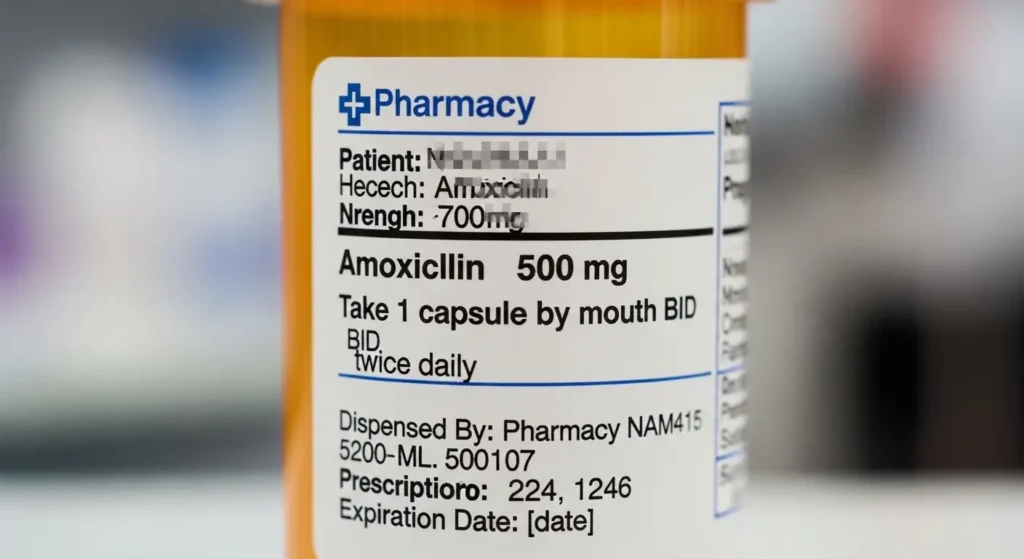
You’re standing in your kitchen, holding a brown plastic bottle of pills, staring at a label that looks more like a secret code than a set of instructions. Your head is pounding, you’re tired, and all you want to do is take your medicine and feel better. Instead, you see three little letters—B.I.D.—and suddenly you’re second-guessing everything. Does it mean twice a day? Every two hours? Do you take them together or spread them out?
Last updated: June 9, 2026
it’s incredibly stressful when your recovery depends on a “code” you don’t fully understand. You aren’t a doctor, and you shouldn’t need a medical degree just to take your blood pressure medication correctly. This guide is here to clear the fog. We are going to break down the bid medical abbreviation so you can manage your health with total confidence and zero guesswork.
What is the BID Medical Abbreviation?
At its simplest, the bid medical abbreviation stands for “bis in die,” which is Latin for “twice a day.” In the fast-paced world of hospitals and pharmacies, doctors use these shorthand codes to save time when writing hundreds of prescriptions. While it sounds fancy, it’s just a way of telling the pharmacist—and you—how often the medication needs to be in your system.
When a clinician writes “BID” on a chart or a prescription pad, they are instructing you to take the medication two times within a 24-hour period. it’s one of the most common dosing frequencies you will ever encounter, used for everything from basic antibiotics like Amoxicillin to chronic heart medications.
The BID Medical Abbreviation Explained with a Real Scenario
Let’s look at a real-world example to see why the bid medical abbreviation matters for your daily routine. Imagine Sarah has just been diagnosed with a sinus infection. Her doctor prescribes an antibiotic and the label reads: “Take 500mg BID for 10 days.”
Sarah wakes up at 7:00 AM and takes her first pill with breakfast. If she takes her second pill at 11:00 AM because she “wants to get it over with,” she is making a mistake. By 11:00 PM, the level of medicine in her bloodstream will have dropped so low that the bacteria might start growing again.
To follow “BID” correctly, Sarah should aim for roughly 12 hours of separation. Taking one dose at 8:00 AM and the second at 8:00 PM ensures a steady therapeutic level of the drug in her body. This balance is what actually kills the infection, rather than just hitting it hard in the morning and leaving the “fort” unguarded all night.
Passport Publix: The Ultimate Guide for Associate Access
How to Correctly Schedule Your BID Medication
Managing a twice-daily schedule sounds easy until life gets in the way. Follow these steps to ensure you are using the bid medical abbreviation instructions effectively without missing a beat:
-
Check the “Food” Requirement: Before setting your times, ask your pharmacist if the drug needs to be taken with food. This will dictate your “anchor” times (usually breakfast and dinner).
-
Aim for the 12-Hour Split: Ideally, “twice a day” means every 12 hours. If you take your first dose at 9:00 AM, try to take the second at 9:00 PM.
-
Set “Smart” Alarms: Don’t just rely on your memory. Use a smartphone app or a standard alarm labeled “Dose 1” and “Dose 2.“
-
Use a Pill Organizer: Even with BID dosing, it’s easy to forget if you already took your morning pill. A “Morning/Evening” pillbox provides a visual confirmation.
-
Be Consistent: Try to stay within a two-hour window of your scheduled time every single day to keep the drug concentration stable in your blood.
Common Mistakes People Make with BID Dosing
The biggest mistake is “doubling up” after a missed dose. If you realize at 4:00 PM that you forgot your 8:00 AM pill, many people take two pills at once for their evening dose. This can be dangerous, as it spikes the drug levels in your body, potentially leading to toxicity or severe side effects.
Another frequent error is ignoring the “Circadian” factor. Some medications labeled BID actually work better if spaced specifically around your sleep cycle. For instance, certain reflux medications might be “BID,” but your doctor might specifically want one dose before your largest meal and one before bed, which might only be 6 hours apart.
Finally, people often confuse BID with “PRN” (as needed). If your bottle says BID, it’s a scheduled requirement. You don’t just take it when you feel symptoms; you take it to prevent the symptoms from coming back. Skipping the “wellness” doses is the fastest way to a relapse.
BID vs. Other Common Dosing Terms
Medical shorthand can get confusing quickly. Use this comparison table to distinguish the bid medical abbreviation from other instructions you might see on your labels.
| Abbreviation | Latin Root | Meaning | Typical Schedule Example |
| BID | Bis in die | Twice a day | 8:00 AM and 8:00 PM |
| TID | Ter in die | Three times a day | 8:00 AM, 2:00 PM, and 8:00 PM |
| QID | Quater in die | Four times a day | Every 6 hours (e.g., 6, 12, 6, 12) |
| QD | Quaque die | Once a day | Same time every morning |
| Q12H | Quaque 12 hora | Every 12 hours | Exact 12-hour intervals (Strict) |
Note: While BID and Q12H both result in two doses a day, Q12H is a stricter clinical requirement. BID allows for some flexibility around mealtimes, whereas Q12H is often used for high-stakes meds like heart anti-arrhythmics that require an exact clock-face schedule.
Pro Tips and Best Practices for Patient Safety
If you find that a 12-hour split is impossible for your lifestyle—perhaps you work a night shift or have an erratic schedule—talk to your pharmacist. Many BID medications can be adjusted to a 10/14 hour split (e.g., 8:00 AM and 6:00 PM) without losing efficacy. They can tell you if your specific drug is “forgiving” or if it requires strict timing.
Another expert tip: Watch for the “hidden” BID. Sometimes, a doctor won’t write BID but will write “q.am & q.hs” (every morning and at bedtime). This is functionally the same thing but adds specific timing to the instructions. Always clarify if you see multiple instructions that seem to overlap.
Lastly, keep a “Medication List” in your wallet or on your phone. Write down the name of the drug and clearly note “BID – 9 AM / 9 PM.” If you are ever in an emergency room and can’t speak for yourself, this clear breakdown tells the medical team exactly how much of the drug is currently in your system.
Frequently Asked Questions
Does BID mean exactly every 12 hours?
Not necessarily. While 12 hours is the ideal goal, BID is generally interpreted as “during waking hours, twice a day.” Unless the label says “Strictly every 12 hours,” a bit of flexibility (like 8:00 AM and 7:00 PM) is usually acceptable.
Can I take BID meds on an empty stomach?
This depends entirely on the drug. Some medications, like certain NSAIDs (painkillers), must be taken with food to protect your stomach lining. Others, like certain thyroid meds, must be taken on an empty stomach. Always check the auxiliary labels (the small colorful stickers) on your bottle.
What should I do if I miss a BID dose?
Generally, if you remember within a few hours, take the dose. If it’s almost time for your second dose, skip the missed one and get back on track. Never double the dose to catch up unless your doctor specifically told you to.
Is BID the same as “every 12 hours”?
They are very similar, but “every 12 hours” (Q12H) is more precise. BID is often used for convenience to match a patient’s meal schedule, while Q12H is used for medications that need a very specific, constant level in the blood.
Why do doctors use Latin abbreviations like BID?
it’s a historical tradition that provides a universal language for healthcare. Regardless of what language a doctor speaks, “BID” is a standardized instruction recognized globally, which helps reduce errors when transferring records between different countries or systems.
Can I change my BID meds to QD (once a day) if I take a higher dose?
Absolutely not. The frequency (BID) is often more important than the total amount. Your liver or kidneys process some drugs very quickly; if you take the whole amount once, it will be gone from your system by the afternoon, leaving you unprotected.
Your Next Step for Medication Safety
Understanding the bid medical abbreviation is a huge win for your personal health literacy. You are no longer just “taking pills”; you are managing a chemical balance in your body like a pro. However, knowledge is only useful if you act on it.
Your immediate action item: Go to your medicine cabinet right now. Look at your current prescriptions. If you see “BID” or “Twice Daily,” check your phone alarms or your pillbox to ensure you have a consistent 12-hour gap between those doses. If your timing has been all over the place, tomorrow is the perfect day to start your new, consistent routine.
By taking control of your schedule, you ensure your medication works exactly the way your doctor intended, getting you back to feeling like yourself much faster.
Source: edX
Related Articles
- Kubik Geneve: The Art of Precision Swiss Watchmaking
- the Life and Legacy of Claude Elkins: A Creative Force
- the Future of Streaming: An In-Depth Look at Crackstream AI
Editorial Note: This article was researched and written by the Floral Loft SAC editorial team. We fact-check our content and update it regularly. For questions or corrections, contact us.
Related read: Mohandas Gandhi Mahatma Gandhi: Navigating His Enduring Legacy in 2026.