
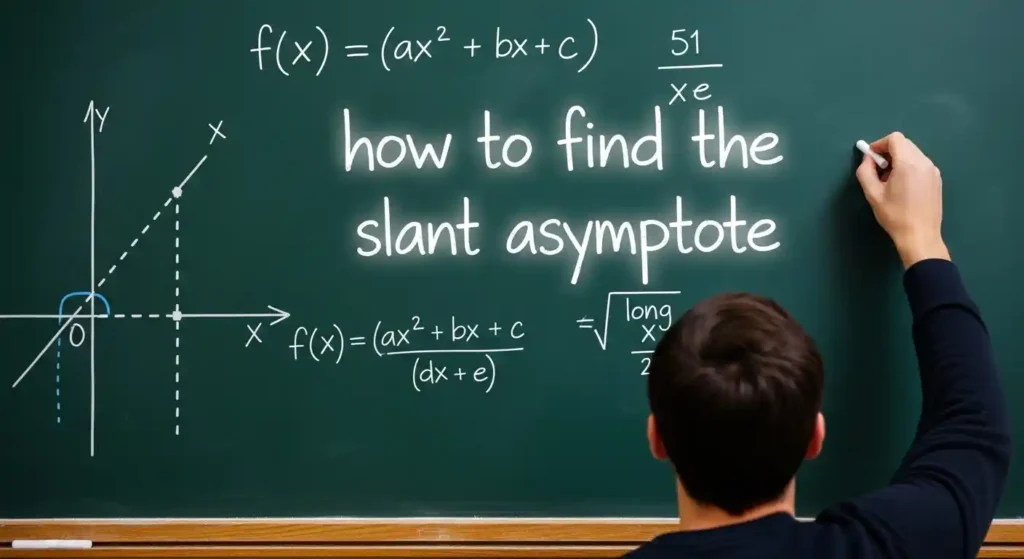
If you’ve ever graphed a rational function and noticed the curve heading toward a diagonal line instead of a flat one, you’ve already seen a slant asymptote in action. Knowing how to find the slant asymptote is one of those skills that feels tricky at first but becomes second nature once you understand the logic behind it. In this guide, we’ll walk through everything — from what slant asymptotes actually are, to step-by-step methods, real examples, and the mistakes most students make along the way.
Last updated: June 9, 2026
What Is a Slant Asymptote?
A slant asymptote (also called an oblique asymptote) is a diagonal line that a curve approaches as x heads toward positive or negative infinity. Unlike horizontal asymptotes, which are flat, slant asymptotes have a slope. They show up in the form:
y = mx + b
where m ≠ 0.
You’ll typically encounter slant asymptotes when working with rational functions — that’s, a polynomial divided by another polynomial.
When Does a Slant Asymptote Exist?
A rational function f(x) = P(x) / Q(x) has a slant asymptote when the degree of the numerator is exactly one more than the degree of the denominator.
For example:
- Numerator degree = 3, Denominator degree = 2 → slant asymptote exists
- Numerator degree = 2, Denominator degree = 2 → horizontal asymptote (not slant)
- Numerator degree = 4, Denominator degree = 2 → neither slant nor horizontal (curve diverges)
This one rule saves a lot of confusion before you even start calculating.
How Long to Boil Yellow Potatoes (Perfect Every Time)
How to Find the Slant Asymptote Using Polynomial Long Division
The most reliable method to find a slant asymptote is polynomial long division. Here’s how to do it clearly.
Step-by-Step Method
Step 1: Check that the degree of the numerator is exactly one more than the denominator. If not, stop — there’s no slant asymptote.
Step 2: Divide the numerator by the denominator using long division.
Step 3: Write down the quotient (ignore the remainder entirely).
Step 4: The slant asymptote is y = quotient.
That’s really it. The remainder becomes irrelevant because as x → ±∞, the remainder term approaches zero.
Practical Example 1
Find the slant asymptote of:
f(x) = (x² + 3x + 5) / (x + 1)
The numerator has degree 2, denominator has degree 1. Degree difference = 1. So a slant asymptote exists.
Now divide x² + 3x + 5 by x + 1:
- x² ÷ x = x → multiply: x(x + 1) = x² + x → subtract: (3x − x) + 5 = 2x + 5
- 2x ÷ x = 2 → multiply: 2(x + 1) = 2x + 2 → subtract: 5 − 2 = 3 (remainder)
Quotient = x + 2, Remainder = 3
Slant asymptote: y = x + 2
Using Synthetic Division as an Alternative
For simpler cases where the denominator is a linear binomial like (x − a), synthetic division works just as well and is often faster.
Practical Example 2
Find the slant asymptote of:
f(x) = (2x² − x + 4) / (x − 3)
Using synthetic division with root 3:
Coefficients: 2, −1, 4
- Bring down 2
- 2 × 3 = 6 → −1 + 6 = 5
- 5 × 3 = 15 → 4 + 15 = 19 (remainder)
Quotient = 2x + 5
Slant asymptote: y = 2x + 5
Quick and clean. Synthetic division is a great shortcut when applicable.
Pros and Cons of Each Method
Polynomial Long Division
Pros:
- Works for any denominator, linear or not
- Shows full working clearly
- Reliable and universally applicable
Cons:
- Takes more time with higher-degree polynomials
- Easy to make arithmetic errors mid-way
Synthetic Division
Pros:
- Much faster for linear denominators
- Less writing involved
- Great for timed tests
Cons:
- Only works when the denominator is linear (degree 1)
- Doesn’t apply to quadratic or higher denominators
Common Mistakes to Avoid
Even students who understand the concept trip up on small things. Here are the most frequent errors:
- Ignoring the remainder — Some people include the remainder in the asymptote equation. Don’t. Drop it completely.
- Wrong degree check — Always verify that the numerator’s degree is exactly one greater than the denominator’s. Off by one in either direction and there’s no slant asymptote.
- Confusing slant with horizontal — When degrees are equal, you get a horizontal asymptote, not a slant one. These are different things.
- Sign errors during division — Especially when subtracting polynomials. Double-check every subtraction step.
- Assuming every function has one — Not all rational functions have slant asymptotes. Check first before calculating.
Best Practices for Finding Slant Asymptotes
Follow these habits and you’ll rarely go wrong:
- Always check degrees first. Before picking up a pencil, compare the degree of the numerator and denominator. This saves time immediately.
- Rewrite in standard form. Make sure your polynomials are arranged in descending order of degree before dividing. Missing terms should be written with a coefficient of zero (e.g., x³ + 0x² + 2x − 1).
- Use placeholders for missing terms. If your numerator is x³ + 5 with no x² or x term, write it as x³ + 0x² + 0x + 5. This prevents misalignment during division.
- Verify by graphing. Once you find the asymptote, plug in a large value of x (like 1000 or −1000) and check that f(x) is close to y = mx + b.
- Practice with varied examples. Try functions with negative leading coefficients, fractions, and binomials in the numerator to build confidence.
Can a Curve Cross Its Slant Asymptote?
Yes — and this surprises a lot of people. Unlike vertical asymptotes, a curve can cross a slant asymptote at some finite point. The asymptote only describes the behavior as x approaches infinity, not everywhere along the graph. So finding the asymptote and graphing the full function are two separate exercises.
Slant Asymptotes vs. Other Asymptotes: A Quick Comparison
It helps to see all three types side by side:
| Type | Direction | When It Occurs |
|---|---|---|
| Vertical | Up/Down | Denominator = 0 |
| Horizontal | Left/Right | Degrees equal or numerator lower |
| Slant/Oblique | Diagonal | Numerator degree = denominator degree + 1 |
Understanding this table makes it easy to immediately classify what kind of asymptote you’re looking for before diving into any calculation.
Conclusion
Finding slant asymptotes doesn’t have to feel overwhelming. Once you know the degree rule and get comfortable with polynomial long division (or synthetic division for linear cases), the process becomes very manageable. The key is to always check degrees first, divide carefully, drop the remainder, and you’re done. With a bit of practice, spotting and solving for oblique asymptotes becomes one of the more satisfying parts of working with rational functions. Keep these steps handy, avoid the common mistakes listed above, and you’ll handle any slant asymptote problem that comes your way.
Frequently Asked Questions
1. What is the easiest way to find the slant asymptote?
Polynomial long division is the most straightforward method. Divide the numerator by the denominator, take the quotient, and ignore the remainder. That quotient is your slant asymptote.
2. How do you know if a function has a slant asymptote?
A rational function has a slant asymptote only when the degree of the numerator is exactly one greater than the degree of the denominator. If the difference is zero or more than one, it won’t have a slant asymptote.
3. Can a rational function have both a slant and a horizontal asymptote?
No. A rational function can have one or the other, not both. If the degrees are equal, you get a horizontal asymptote. If the numerator’s degree is one higher, you get a slant asymptote.
4. Does the remainder affect the slant asymptote?
No. The remainder is always dropped. As x approaches infinity, the remainder term approaches zero, so it has no impact on the asymptotic behavior.
5. Can I use limits to find slant asymptotes?
Yes, but it’s more complex. You can compute lim(x→∞) [f(x)/x] to find the slope m, then lim(x→∞) [f(x) − mx] to find the intercept b. However, for most problems, long division is faster and more practical.
Source: edX
Related Articles
- Is Crackstreams Safe? An In-Depth Look at Streaming
- Luxury: A Complete Guide to VIP Box TC Experience
- the Evolution of Fesbuka: A Journey Through Digital Communication
Editorial Note: This article was researched and written by the Floral Loft SAC editorial team. We fact-check our content and update it regularly. For questions or corrections, contact us. For readers asking “How to find the slant asymptote”, the answer comes down to the specific factors covered above.