
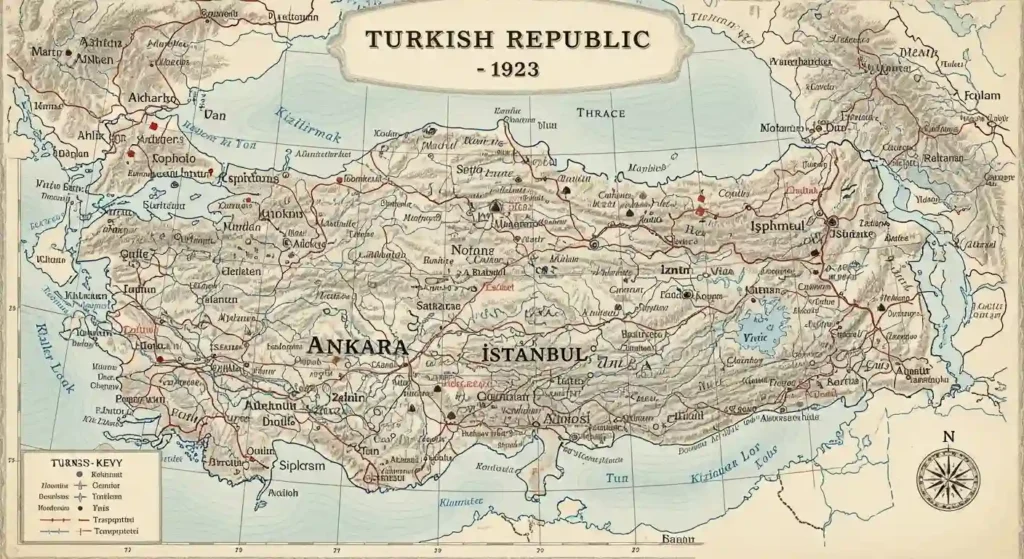
If you’ve ever studied modern history or followed Turkish culture, you’ve probably come across the word Cumhuriyet. It simply means “republic” in Turkish — but behind that single word lies one of the most dramatic political transformations in the 20th century. The founding of the Cumhuriyet didn’t just change a country’s name. It reshaped an entire civilization.
Let’s take a closer look at what Cumhuriyet really means, how it came to be, and why it still matters today.
What Does Cumhuriyet Mean?
The word Cumhuriyet comes from the Arabic root jumhūriyya, meaning a system of governance by the public. In Turkish, it directly translates to “republic” — a state where power belongs to the people, not a monarch or sultan.
When Mustafa Kemal Atatürk proclaimed the Turkish Republic on October 29, 1923, he wasn’t just announcing a new government. He was declaring a completely new social contract between the state and its citizens.
This shift was monumental. For centuries, the Ottoman Empire had ruled under a sultanate and caliphate system. Overnight, that entire structure was dissolved and replaced with a secular, democratic republic.
The Historical Roots of the Turkish Republic
The Fall of the Ottoman Empire
To understand Cumhuriyet, you need to understand what came before it. The Ottoman Empire, once one of the most powerful empires in the world, began crumbling in the 19th century. Military defeats, economic decline, and internal tensions all played a role.
By the end of World War I, the empire was essentially finished. Foreign powers — including Britain, France, and Greece — were carving up Anatolia under the Treaty of Sèvres in 1920.
The Turkish War of Independence
This is where Mustafa Kemal stepped in. Rather than accepting foreign occupation, he organized a national resistance movement from Ankara. Between 1919 and 1922, Turkish forces fought back against occupying armies in what became known as the Turkish War of Independence.
The victory was decisive. The Treaty of Lausanne in 1923 replaced Sèvres and recognized the new Turkish state’s borders — borders that largely remain the same today.
BabydollKaila: The Influencer Redefining Digital Authenticity
October 29, 1923 — The Birth of Cumhuriyet
With military victory secured, Mustafa Kemal moved quickly. On October 29, 1923, the Grand National Assembly officially declared Turkey a republic. Mustafa Kemal became its first president and later took the surname Atatürk, meaning “Father of the Turks.”
This date is still celebrated every year as Cumhuriyet Bayramı — Republic Day — one of Turkey’s most important national holidays.
The Core Principles Behind Cumhuriyet
Atatürk built the new republic on a set of foundational principles known as Kemalism. These six principles are often called the “Six Arrows”:
- Republicanism — sovereignty belongs to the people
- Nationalism — a unified Turkish national identity
- Populism — equality before the law for all citizens
- Secularism — separation of religion from state affairs
- Statism — the state plays an active role in economic development
- Revolutionism — commitment to continuous reform and modernization
These weren’t just political talking points. They were written directly into Turkey’s constitution and reshaped every aspect of daily life — from education and law to clothing and the alphabet.
How Cumhuriyet Changed Everyday Life
The Alphabet Revolution
One of the most visible reforms came in 1928. Atatürk replaced the Ottoman Arabic script with a new Latin-based Turkish alphabet. This wasn’t just a language change — it was a deliberate break from the Ottoman past and a push toward Western modernity.
Literacy rates, which were extremely low under the empire, began rising steadily after this reform.
Women’s Rights
The Turkish Republic became surprisingly progressive for its time on women’s rights. Turkish women gained the right to vote in national elections in 1934 — before women in France (1944) or Italy (1945).
Secularism in Law and Society
Religious courts were abolished. The caliphate was dismantled. Civil law replaced Sharia in legal matters. These were radical moves in a Muslim-majority country, and they sparked ongoing debates that continue even today.
Pros and Cons of the Cumhuriyet System
Pros
- Democratic foundation — citizens hold political power through elections
- Secular governance — religion and state are formally separated
- Modern legal framework — civil and criminal codes based on European models
- Women’s empowerment — early recognition of women’s political rights
- National unity — strong sense of shared Turkish identity
Cons
- Minority rights tensions — Kurdish and other minority groups have historically faced restrictions
- Military interventions — Turkey experienced several military coups (1960, 1971, 1980, 1997), raising questions about democratic stability
- Secularism debates — ongoing tension between secular and religious segments of society
- Press freedom concerns — critics have noted restrictions on media and political opposition at various points in history
- Centralized power — the presidential system has raised checks-and-balances concerns in recent years
Common Mistakes People Make When Studying Cumhuriyet
Understanding the Turkish Republic is often complicated by a few persistent misconceptions:
1. Thinking it was purely a top-down imposition Many people assume the republic was simply forced on a passive population. In reality, there was genuine popular support for independence and reform after the suffering of World War I and occupation.
2. Confusing secularism with anti-religion Kemalist secularism meant separating religion from state functions — not banning religious practice. Mosques remained open. Religion continued as a personal matter.
3. Ignoring the ongoing evolution The Turkish Republic of 1923 looks quite different from Turkey today. The country has gone through multiple constitutions, democratic transitions, and political shifts. It’s not a frozen historical moment.
4. Overlooking the economic dimension Political transformation was matched by ambitious economic planning. State-led industrialization was central to building a functioning modern nation from the ruins of an empire.
Best Practices for Understanding Cumhuriyet
If you want to genuinely understand the significance of the Turkish Republic, here are a few approaches that work well:
- Read primary sources — Atatürk’s speeches and the early republican constitutions offer direct insight into the founders’ vision
- Study comparative history — comparing Turkey’s transition with other post-imperial republics (like Weimar Germany or post-Ottoman Arab states) adds valuable context
- Engage with Turkish perspectives — Turkish historians, journalists, and scholars offer nuanced views that outside sources often miss
- Follow current events — the debates around Cumhuriyet’s legacy are very much alive in Turkish politics today
- Visit Turkey’s cultural institutions — museums in Ankara and Istanbul, including the Atatürk Mausoleum (Anıtkabir), bring the history to life
Conclusion
Cumhuriyet is far more than a vocabulary word. It represents a bold, often turbulent experiment in building a modern nation from the ruins of a centuries-old empire. The Turkish Republic that emerged in 1923 was shaped by war, vision, and an extraordinary determination to chart a new course.
Whether you view it with admiration or critical scrutiny, there’s no denying its historical significance. The founding of the Cumhuriyet changed the map of the Middle East, inspired nationalist movements across the region, and continues to influence Turkish identity to this day.
Understanding it isn’t just about understanding Turkey — it’s about understanding how nations reinvent themselves.
Frequently Asked Questions (FAQs)
1. What does Cumhuriyet mean in English?
Cumhuriyet is the Turkish word for “republic.” It refers to a system of government where sovereignty rests with the people, represented through elected officials.
2. When was the Turkish Republic (Cumhuriyet) founded?
The Turkish Republic was officially proclaimed on October 29, 1923, by Mustafa Kemal Atatürk following the Turkish War of Independence.
3. Why is Cumhuriyet Bayramı celebrated on October 29?
October 29 marks the date in 1923 when the Grand National Assembly declared Turkey a republic. It is celebrated annually as Republic Day, one of Turkey’s most significant national holidays.
4. What were the main reforms introduced after Cumhuriyet was established?
Key reforms included the adoption of a Latin-based alphabet, the abolition of the caliphate, introduction of secular civil law, women’s voting rights, and widespread educational expansion.
5. How does Cumhuriyet influence Turkey today?
The republic’s founding principles — particularly secularism and nationalism — continue to shape Turkish political debates, constitutional discussions, and national identity in the present day.